
Funding Goal
Calculate how much you should raise and why
What is Funding Goal?
How to use Funding Goal?
Features
Use Cases
FAQ
Pricing
Free Plan
$0/month
AngelMatch Platform
Contact for Pricing
Calculate how much you should raise and why
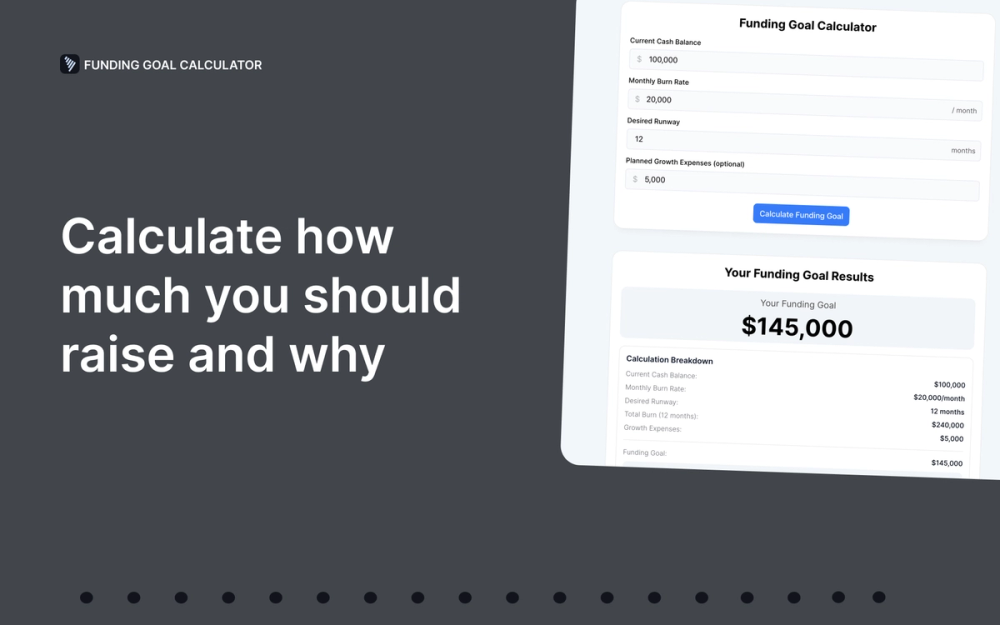
Funding Goal Calculator is a free online tool by AngelMatch that helps startups and entrepreneurs determine the optimal amount of funding to raise for their business. This intelligent calculator analyzes your business needs, runway requirements, and growth projections to provide data-driven funding recommendations. By considering factors like burn rate, hiring plans, and development milestones, it helps founders avoid the common pitfalls of raising too little or diluting equity unnecessarily by raising too much.
Intelligent burn rate analysis that projects monthly spending based on your growth trajectory and hiring plans Runway calculator that determines optimal funding amounts for 12, 18, or 24-month runways Team cost projections with customizable roles, salaries, and hiring timelines Milestone-based planning to align funding needs with product development and growth goals Scenario modeling to compare different funding strategies and their impact on runway Industry benchmarks to validate your assumptions against similar companies and stages Export functionality to save calculations and share with co-founders or advisors
#1 Pre-seed founders determining how much to raise for their first institutional round based on MVP development needs #2 Seed-stage startups calculating Series A requirements by projecting 18-month runway with aggressive hiring plans #3 Growth-stage companies modeling bridge rounds or Series B amounts based on expansion and scaling costs #4 First-time founders validating their funding assumptions against industry standards before investor meetings #5 Financial planners helping startup clients structure realistic budgets and funding roadmaps #6 Accelerator programs teaching cohort participants how to calculate appropriate raise amounts
What factors should I consider when calculating my funding goal? Key factors include your monthly burn rate, planned team size and hiring timeline, product development costs, marketing and customer acquisition expenses, operational overhead, desired runway length (typically 12-18 months), and a buffer for unexpected expenses (usually 20-30% contingency).
How long should my runway be after raising funding? Most investors prefer startups to raise enough for 18-24 months of runway. This provides sufficient time to hit meaningful milestones, de-risk the business, and raise the next round from a position of strength rather than desperation. Seed-stage companies often target 18 months, while later stages may plan for 24+ months.
Should I raise more money if investors are willing to give it? Not necessarily. While it's tempting to maximize raise amount, taking more capital than needed can lead to unnecessary dilution and higher valuation pressure for your next round. Raise enough to hit your next milestone plus a reasonable buffer, but avoid over-raising just because capital is available.
How do I account for revenue in my funding calculation? If you have existing or projected revenue, subtract your expected revenue growth from your gross burn rate to calculate net burn. Conservative projections are recommended - use only contracted or highly probable revenue when calculating funding needs, especially for early-stage companies.
What's the difference between gross burn and net burn? Gross burn is your total monthly expenses before revenue, while net burn is expenses minus revenue. Early-stage pre-revenue companies typically focus on gross burn, while companies with traction should calculate both to show improving unit economics and path to profitability.